
Communication Is Not Enough. Why Transformations Fail Before They Even Start.

Organizations confuse talking at people with working with them. They’ve been doing it for years. Working with people is a well-kept secret that does the magic in transformations. Most adoption plans have a communication strategy. Almost none have an engagement strategy. And people wonder why nobody bought in. But! Communication is not engagement. Sending information is easy.Creating involvement is harder. Communication tells people what is happening.Engagement helps them shape it, question it, test it, and believe they have a place in it. One informs. The other involves. Engagement isn’t a phase you check off before Go Live. It’s the ground you prepare—so that when communication lands, it actually hits the nail. Real engagement is bidirectional. It requires relationship infrastructure. It measures influence, sentiment, and the quality of what people actually tell you back. Engagement starts much earlier:in the workshop where people name what will really change,in the pilot where you test what is believable and doable,in the manager engagement session where leaders and transformation teams stop hiding behind slides,in the ambassador network where trust travels faster than email,in the feedback loop where people see their input changed something. Communication measures open rates. Engagement measures commitment. Commitment is what makes adoption real. If your transformation doesn’t have change-impact workshops, co-creation sessions, manager alignment conversations, pilot groups, or ambassador networks built in – you don’t have an engagement strategy. You just have a one-way communication plan. And communication on its own doesn’t change behavior. Co-creation, engagement, involving people do. What are you building first in your change efforts – communication, or engagement? How to create engagement that strengthens adoption is one of the modules in Change Essentials programme. I invite you to join this programme if you want to create people’s commitment and involvement.
Are you good at building relationships?

No, I’m not asking you into a relationship. But I do want your changes to work. I’m asking because this is exactly what decides today whether a technology change in a company really lands well. We are all focused on the tools. AI. New platforms. New processes. New ways of working. But technology does not create change on its own. People do. And people do not follow a system. They follow trust, collaboration, and relationships. When I speak about my experience implementing new technology in different countries, relationship building is exactly what created the foundation for high adoption and engagement. Not Excel. Not a slide deck. Not a perfectly documented project plan. Relationships. With the sponsor – the global leader. With the programme manager. With the subject matter experts most affected by the change. With HR teams in each country. With change ambassadors. With different local groups impacted by the change. That is what created the space for trust, openness, faster responses to people’s concerns, and better collaboration across the whole change journey. And it’s not only my experience. Prosci has consistently shown that employee engagement is one of the top factors in successful change. Deloitte confirms that high-performing teams are built on respect, trust, and support. McKinsey reminds us that without real buy-in and role modelling from leaders, transformation starts to stall. And psychology is almost uncomfortably clear on this point: in moments of uncertainty, people first assess whether they are safe – and only then do they listen to what is actually changing. So no: First the system, then the people. More like: First relationships, then collaboration, and only then real adoption. Relationships cannot be rolled out like new software. They cannot be generated with a prompt. They are built slowly. Consistently. Through presence. How consciously are you building relationships in your team today – before asking people to go through yet another change?
MYTH #02

But we communicated it to people “I didn’t know this was happening.” Forty-seven messages. And people still didn’t feel informed. “We told them everything. We did the maximum.” Over six months, we sent 47 separate communication items – newsletters, town hall recordings, videos from the director, plenty of emails.” Everything was prepared. Everything was sent. Everything went according to plan. “I didn’t know this affected me.” That statement did not come at the beginning. It came late. Nine months after implementation, adoption was at 31 percent. Management could not understand it. “This is the maximum we could have done.” No. This was the maximum you could have broadcast. Because the problem here was not signal strength. The signal was strong. The problem was reception. A signal that is too strong turns into noise. And noise is something the brain automatically ignores. Not out of resistance. Not out of indifference. It is a survival mechanism. And that is the lie companies keep repeating to themselves again and again: “If we communicated it a lot, we communicated it well.” You didn’t. You communicated it often. That is something entirely different. In week seven of the transformation, employees received three separate emails about the new system in a single day. Each from a different sender. Each with a different emphasis. Each marked as important. By week fourteen, most of them could visually recognise the transformation newsletter header – and closed it before even opening it. Forty-seven items did not create awareness. They created an escape reflex. After every town hall, after every GMs video, employees could quote the transformation strategy. They knew the company was “going digital.” They knew the platform would bring “efficiency and transparency.” But no one could answer these three ordinary questions: That is not a lack of information. That is a lack of translation. The organisation had an excellent communication plan. But it forgot how to ensure understanding of the impact and a mindset shift. And so a gap opened between information and understanding. A gap into which 69% of users fell. Employees do not understand the meaning of change through a corporate newsletter – especially one they have already learned to ignore. They understand it through familiar faces: their direct managers or colleagues. Through questions asked in a close and familiar environment. Through someone who can say: “For our team, this specifically means this…” Prosci’s research is very clear on this point: Employees prefer to hear messages about the personal impact of change from their direct manager – not from HR, not from a communications team sitting somewhere at headquarters But from the person standing with them every Monday morning in the team meeting. This company sent 47 messages through central channels. Sending the same message content to everyone is not communication. William Bridges separated two things that organisations still keep confusing: Change = the external event. Transition = the internal psychological process. Companies manage the change. They leave the transition to chance. You can send people 47 accurate pieces of information about a change and still leave them completely alone in the process shifting their minds. A mindset shift does not happen on the intranet. It happens in an employee’s head on Monday morning when they open the new system and do not know what to do if it does not work. At that moment, the GMs video does not help. Neither does the newsletter they have trained themselves to stop reading. What helps is a manager or a change ambassador who has already gone through it with them. Or no one helps. And adoption stays at 31 percent. People were informed. They were not prepared. A strong signal ≠ change adoption How is it in your organisation? What other ways does your organisation use when introducing change?
New job reality
It is already starting to peek through every crack and in every direction. And Forbes has finally written about it. “Job roles are breaking apart.” The pressure is rising. Burnout is just around the corner. “Traditional job positions are gradually breaking down into individual tasks that can be carried out by different types of workers – employees, external specialists, or the technologies themselves.” *(Forbes)* I agree. But at the same time, I keep thinking – what is no one saying out loud? Until now, most of the conversation has focused mainly on AI, automation, and new technologies. On tools. On productivity. On the future of work. On early adopters eagerly jumping into the new. But the most important part has stayed in the background for far too long: What is all of this doing to people? Very few people stop to think about the 70% who need time to accept change. And yet Forbes itself writes: “Many employees are facing growing pressure to perform, alongside a higher risk of burnout. According to a number of studies, low employee engagement is among the main factors reducing company productivity.” Companies invest in tools. In processes. In technologies. Very few invest in how to actually help people move through that change. This is not a side issue. This is reality – and it is already affecting companies, teams, and individuals. So far, I have seen very little discussion about what these changes are doing to people’s mental wellbeing, their confidence, their identity, their sense of direction in life. Forbes mentions adaptability and soft skills as part of the answer. “Companies are also increasingly pointing to a lack of soft skills, such as collaboration, adaptability, or critical thinking.” And I would add one more capability that is still talked about far less than it deserves: The ability to go through change in a healthy, conscious, and supported way. Not only for employees. But also for managers. And yes, at C-level too. Because: → Adaptability does not develop from a workshop on growth mindset → The ability to handle change does not appear automatically in a job description → Working with emotions during transition is not “soft” – it is a hard business issue Change in work is inevitable. How people handle that change – that is a choice. People need to learn how to deal with change. How to work with uncertainty. How to understand their own emotions. How to maintain their value in a world where work is being rewritten in real time. What about you – is your company investing in people’s ability to navigate change, or only in the change itself?
The Most Underrated Skill in Change Management

And Why It Makes You Difficult There’s a long list of skills a modern change professional is expected to master. We debate them on here endlessly – resilience, collaboration, analytical thinking, curiosity. All important. All part of the craft. But one skill determines whether change succeeds or quietly collapses: TRANSPARENCY Not the fluffy version. The uncomfortable, truth-naming, reality-surfacing kind. The kind that makes you that person in the room – the one who asks the question nobody wants to touch, who says what everyone feels but avoids, who refuses to wrap complexity in pretty language. This is the moment collaboration becomes a #paradox: You serve the team best by risking being unpopular. In my view without transparency: And nothing derails a transformation faster than hidden truths that explode too late. Modern change management isn’t just guiding people through complexity of change. It’s naming the complexity before it catches on you. Transparency isn’t a soft skill. It’s a strategic one. And the teams who understand this – win. Which team are you? The one that plays nice and hides the uncomfortable truth? Or the one that really cares and shows good, bad and ugly?
5 mistakes I made before I knew what change management is

Every mistake I made early in my career became a lesson I now incorporate in change strategy. Which one shaped you the most? In my early HR Executive days, “change projects” often landed on my desk for one simple reason: Someone wanted to save costs or had a preferred supplier. Back then, I didn’t know much about change management. I simply rolled up my sleeves and got to work. Looking back now – from my change strategist seat – I see the blind spots clearly. ✨ Mistake #1 – Jumping in without the WHYI delivered the change before defining why it mattered – for the business and, more importantly, for the people affected. ✨ Mistake #2 – Focusing only on the tip of the icebergWe never gathered real business requirements or assessed change impacts. We assumed the obvious was obvious – it wasn’t. ✨ Mistake #3 – No structured planEverything was done intuitively. We reacted instead of anticipating. There was no roadmap to guide us through uncertainty. ✨ Mistake #4 – No back-up planWhen things backfired (and they did), we were surprised instead of prepared. ✨ Mistake #5 – Trying to change leaders, not approachesI thought I could shift their mindset without their buy-in.Lesson learnt: without motivation and understanding, there’s no will to change. These early career missteps shaped how I approach change today – with clarity, structure, and heart. Because every transformation deserves more than good intentions. It deserves a plan, a purpose, and people who understand the why.
How expensive is change?

Having a change manager / change management professional on the transformation project is too expensive. We don’t need anyone to work with change, our HR department can do that. Or even better Project manager can sure cover this. It’s just a communication that needs to be send out. How many times have you heard this? Or lived this? And yes, this is when change becomes a very expensive item in your final transformation bill. Why is that? People don’t have clarity on WHY this is happening. And what is changing for them. Change gets delivered by a surprise communication. There is no buy-in. No trust. Stakeholders feel left out and don’t support the change. No room for feedback from impacted groups because the change is being done in “a secrete room with chosen ones”. And this results in no or a very low adoption. People going back to their old ways of working. Managers not supporting the change and standing on the side of employees. Money thrown out of the window. This can all be a different story only if: You hired the change management expert to work on the strategy and change management plan You included change management expert into decision making, not only into activities delivery. You trained your HR department on how to deliver transformation following the full change management cycle Do you want to know more how to deliver business transformations that work and last – for business and for people? How expensive is change? Sometimes change looks “too expensive”. Sometimes it looks like “just comms”. Sometimes it looks like “HR or the PMO can cover it on the side” I keep hearing: “We don’t need a change manager.” “HR can handle the people stuff.” “It’s just a communication that needs to be sent out.” That’s exactly when change becomes one of the most expensive items on your transformation bill. Because here’s what usually happens when you SAVE on change: → People have no clarity on WHY this is happening → They don’t know WHAT is actually changing for *them → The new way of working arrives as a surprise announcement → Stakeholders feel left out of decisions and quietly stop supporting the change → Feedback from impacted groups never makes it into the design And the result? Low or zero adoption. People drifting back to old processes. Managers standing with employees on the sidelines instead of backing the change. That’s not resistance. That’s money thrown out of the window the form of: – Rework and extra fixes – Delayed benefits – Shadow processes and manual workarounds – Another “failed transformation” people remember next time you launch something big Because here’s the truth: ❌ Skipping change management ≠ saving costs ❌ Handing it to “comms” ≠ building buy-in and trust ❌ Asking HR or the project manager to “cover change” ≠ real engagement It can look very different when you: → Bring in a change expert to co-create the strategy and change plan → Involve them in decision-making, not just in sending emails and running training → Equip your HR and leaders to work with the full change cycle, not only with announcements That’s when your transformation isn’t just delivered. It’s actually used. And it lasts – for the business and for the people. How are you budgeting for change right now: as a cost to cut – or as insurance for your transformation investment?
Change Busters – Busting myths about Change Management
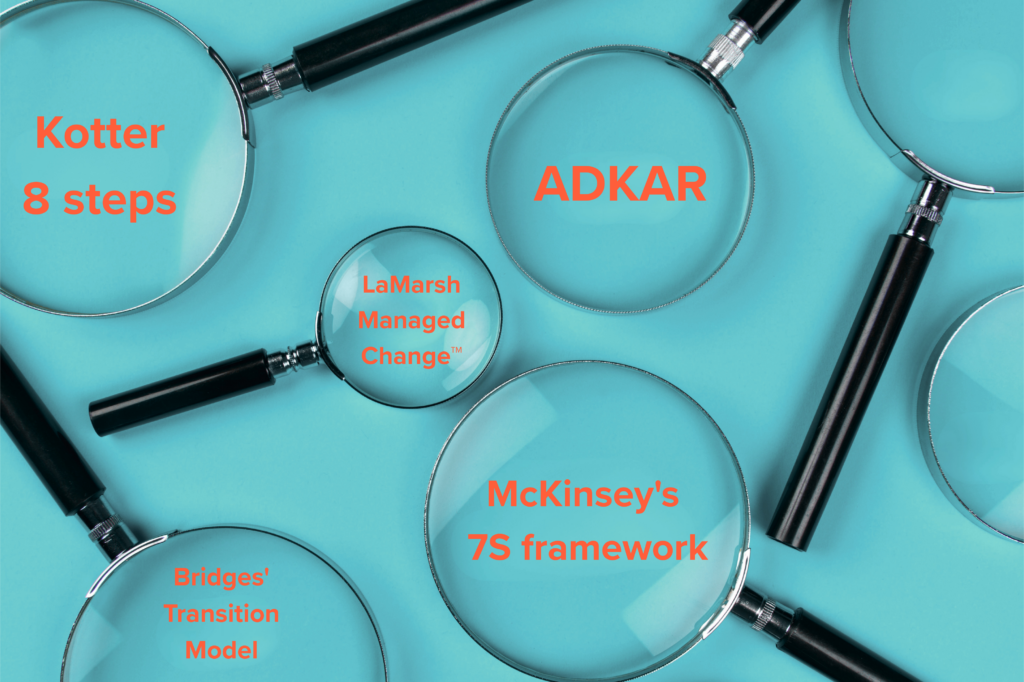
MYTH #01 We have a methodology. That’s enough. The project manager opened the presentation. Fifty-seven slides. A full-page Gantt chart. Phases 1 to 6, a RACI matrix, milestones, KPIs. A certified change management methodology built in — purchased, trained, ready to deploy. Then he turned to the room and said: “We have a plan. People will use it. They have no reason not to.” No one said a word. We have accepted it as a given that technology speaks for itself. AI will save time. The new system will speed up processes. The tool will improve results. You just need to roll it out, show the ROI, send the communication, and organise training. The rest will sort itself out — because who would refuse something that helps them? But this assumption is an expensive one. And it repeats itself in many organisations. People don’t really have a problem with technology. They have a problem with what the technology means. You know that first day in a new job. You don’t know anyone. You don’t know where to get coffee. You don’t know what tone of voice to use in your emails to fit the company culture. Do people use formal language here? Or not? The body feels it before the mind does — a slight tightness in the chest, heightened attention to every little detail, a wave of exhaustion already by mid-afternoon even though you haven’t done anything that demanding. And then someone shows up — someone you know at least a little. A colleague from HR. Your new manager. Someone who gives you their time. They guide you through your first day, explain the logistics, show you the system. They introduce you to two people it feels safe to ask “stupid questions.” They bring you into the context. And suddenly, it works. Not easily — but it works. The fear starts to leave. But the fear doesn’t leave because you have an onboarding document. It leaves because you are starting to understand the context and you have a person guiding you and creating a sense of safety. The same applies to every technology change in an organisation. It does not matter how good the tool is. What matters is: “The system will do this for you” — the brain translates that as: “Your job may no longer be needed.” “AI can handle routine tasks” — the brain translates that as: “Those routine tasks you’ve been doing for ten years, and were doing them well.” Behavioural psychology calls this LOSS AVERSION— the fear of loss is roughly twice as strong as the joy of gain. That is not weakness. According to the SCARF model, when you threaten people’s certainty, autonomy, status, or sense of fairness, the brain often reads it as a threat and retreats into a mode of ignoring or avoiding. At that point, logic and benefits lose. Neuroscience adds another layer: Changing a habit activates the same areas of the brain as physical pain. An old habit is not laziness. It is neurological infrastructure that works — and has a reason to work. Methodologies usually do account for people. But they account for them as a variable that needs to be moved from point A to point B. What a person in point A is thinking, what they feel they are losing, where they see barriers — that is usually not present in any structure or strategy. Organisations that understand this do not work with change as a linear process where people appear only in the implementation phase. They do not ask how to persuade people. They ask what people know — what they value in the current way of working, what they are afraid of losing, what they would change if they could. And they understand the context in which the change is arriving. How many changes this is in the past year. What went wrong last time. How much people trust the person announcing it. Only from that raw information do they shape the change itself. A methodology takes people into account. But it treats them as recipients, not as co-creators. And most of the time, it does not read the context at all. A methodology describes the path. Context determines whether anyone will walk it.
The Future of Change Management Is Not a Single Role. It’s a Change Management Mindset.

I got fired. And it was one of the best things that ever happened to me. Here’s what actually happened… I built change management capability within my junior colleague. He was ready. Fully equipped. Confident. So I was asked to handed over the reins – and the project no longer needed me. That’s the uncomfortable truth about doing change management right. If you do it well… you make yourself redundant. My fellow change practitioner Nissi Ozigbu nailed it recently: modern change managers build capability that lasts. Not dependency. Not a personal empire. Capability. And she’s right. Better equipping everyone with the knowledge, mindset, and skill to navigate continuous change is a win for everyone – business bottom line included. But here’s where most organizations get it wrong: → They treat change management as one person’s job → They hire a change manager and expect magic → They forget that change is constant – and everyone needs to know how to work with it The real legacy isn’t a perfect change plan sitting in SharePoint. Because the future of change management isn’t one hero driving it all. It’s organizations where the capability lives in the culture – not in a single role. This is exactly what the new Change Management Institute research – Futures of Change 2035 – confirms. Today, 72% of people see change management as a project management process. By 2035? Only 20%. Instead, 58% expect change management to become a core leadership capability – and 38% believe it will become an organisational capability, not an individual one. The future of change management is not in more refined methodologies. It is in building the mindset – across teams, roles, and levels. And those who understand this earlier than everyone else will gain the greatest advantage.
5 things I applied in a global technology transformation – and you can do them too.

On paper, implementing technology looks simple. Solution selection – Project plan – Process analysis and new reality – Testing – A few fixes – Communication – Rollout One solution. One plan. Then people enter the picture… and suddenly, in every country, you have: a different reality, different concerns, different constraints. 1) A global change strategy as the anchor Our “bible” – the direction we kept coming back to regularly. But with an open mind. Not dogmatically. 2) Contextual adaptability for each country Same strategy, different execution. Based on the local context and the needs of specific personas. Adaptation is not weakness – it’s precision. 3) Gradual stakeholder involvement by phase Specialists, local leadership, local ambassadors – at the right time. Real involvement beats top-down communication. And it creates an environment of trust and support. 4) A regular rhythm of discussion and feedback Not one-off. Continuously. For change management, this meant spotting early signs of resistance. For the project, it was a source of concrete improvement ideas and a way to uncover weak points directly from users. This is the invisible ROI. 5) Measuring adoption: quantitatively and qualitatively Usage data + satisfaction + what is actually holding people back. This gives you a meaningful picture of reality in the first months.